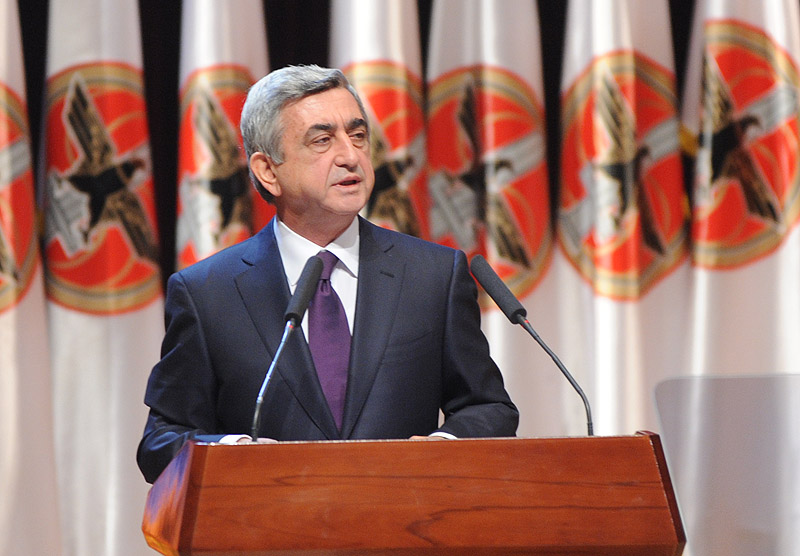


(Հայերեն) Հանրային խորհուրդը կապող օղակ է իշխանության և հասարակության միջև
People, Weekly news | ankakh | July 7, 2010 20:00 Mr. President, Mr. Secretary-General, dear colleagues,
I wish to express my sincere appreciation for the invitation extended to the Civic Council of the Republic of Armenia to attend the AICESIS General Assembly sessions. In this esteemed Assembly I represent my country, the Republic of Armenia, the Civic Council of which submitted a membership request to AICESIS.
As all the constituent republics of the Soviet Union, Armenia gained independence in the aftermath of the collapse of the Soviet empire in 1992. But Armenia was among those few republics, where democratic movement and independence movement began back in 1988, and that were a few steps ahead of the developments that were unfolding in other republics of the Soviet Union, thus making a profound impact on the content, direction and speed of those processes. In 1988, the first nationwide strike was staged in Armenia, while it seemed utterly impossible in the Soviet Union. In 1990, while Armenia was still a part of the Soviet Union, the first multi-candidate parliamentary elections (with real contest between candidates) were held in the country, as a result of which the democratic movement had a prominent presence in the Parliament and formed the Government. Armenia, thus, was the first republic where the Communist party lost its leverage in 1990.
Given the circumstances, it seemed that after gaining independence Armenia would be the first to go ahead fast in nurturing civil society and fledgling democratic institutions.
Besides, another no less important process was unfolding in our region at that time. The people of Karabakh were exercising their right to self-determination through constitutional means on the grounds of the legislation and other legal Acts of the Soviet Union. That movement, which adhered strictly to legality, proved to be a factor that triggered the demise of the USSR setting an example for other nations and inspiring the Baltic republics.
On February 20, 1988, Karabakh Autonomous Region declared through its parliament a secession from Azerbaijan, which was then approved by the referendum conducted (on December 10, 1991) in conformity with the international standards.
Since 80% of Karabakh residents were ethnic Armenians, who lived in their historical homeland, Armenia could not remain indifferent to the processes unfolding in that region. In the aftermath of the collapse of the Soviet Union, when all its constituent republics gained independence (Karabakh was no longer part of Azerbaijan by that time), Azerbaijan declared war on Karabakh as it wished to retake that territory through warfare. However, it failed to achieve that end. We were dragged into war involuntarily. Armenia found herself in a blockade. All communications through Azerbaijan were blocked. Turkey unilaterally closed all communication lines with Armenia and they have been closed since. The roads through Georgia were almost closed because of internal instability, which was a result of hostilities in Abkhazia and South Ossetia. The only remaining route was a narrow mountainous road that connected Armenia with Iran. We found ourselves in a blockade.
It is only natural that by creating social tensions all those developments, the war and the blockade, should have an adverse impact on the processes of formation of democratic institutions in Armenia.
In 2008, aspiring to improve an internal political situation and to promote consolidation of civil society and taking the wishes of various social groups into account, the country’s President initiated the setting up of the Civic Council.
The goals of the Civic Council are:
(a) representation of interests of the Armenian citizens and non-governmental associations in State policy formulation and implementation;
(b) identification and discussion of problems that emerge in various areas of State and public life;
(c) provision of recommendations for State bodies and for public at large;
(d) establishment of traditions that contribute to consolidation of civil society; and
(e) support for civic initiatives that aim to protect rights, freedoms and legitimate interests of Armenian citizens and civic associations.
The Civic Council of the Republic of Armenia is competent to undertake expert evaluation of the Armenian laws and other normative Acts and to hold consultations and hearings with regard to those problems, laws and decisions, which have received much public attention, and to involve citizens and representatives of civic associations and mass media.
Recognition of the important role of the Civic Council in the public life of the country has led to amendments in the Regulations of the National Assembly and the Government thereby enabling the Civic Council to take part in the work of those bodies and to present its position.
As a depoliticized entity, the Civic Council is grounded in the principle of pro bono participation of Armenian citizens and civic associations and of representatives of the Armenian Diaspora.
The Civic Council of the Republic of Armenia is composed of 36 members and 12 area commissions. 12 out of the 36 members were appointed by the Order of the Armenian President and were tasked with setting up 12 area commissions. 960 non-governmental organizations delegated about 2,000 of their representatives to those commissions. At their sessions the commissions elected chairpersons who became other 12 members of the Civic Council. The last 12 members were elected by 24 members the Civic Council.
Addressing the issues of public concern, each commission actively works holding sessions and establishing working groups with a view to reviewing the issues related to a given area. 130 members of the National Academy of Sciences, doctors of science and professors and 310 holders of a Ph.D. degree work in the Civic Council on a pro bono basis. 22% are from the country’s regions. I wish to emphasize that 25% of the commission members are women.
Now I would like to turn to several most important issues that came to the Civic Council’s attention within the past twelve months.
On June 2009, focusing on the issue of amnesty, which was discussed by general public and mass media, the Civic Council organized mass discussions of that issue. As a result, recommendations were made and the groups eligible for amnesty were identified. Those recommendations were submitted to the Armenian President and most of them were incorporated in his recommendation presented to the National Assembly of the Republic of Armenia with regard to declaring an amnesty.
A next very important issue, in the discussion of which the Civic Council of the Republic of Armenia was actively involved, was improvement of Armenian-Turkish relations. It is common knowledge that in 1915 Turkey perpetrated genocide of the Armenian people, as a result of which 1.5 million Armenians lost their lives and hundred of thousands of our countrymen were driven from our historical homeland. Besides, I wish to remind that since 1993 Turkey has unilaterally maintained a blockade of Armenia, which reflects Turkey’s biased stand with regard to Artsakh liberation movement. Under the circumstances an attempt was made to find common ground with the neighboring country. The discussions both in the Civic Council commissions and outside the Civic Council showed that those efforts met with some opposition on the part of the Armenian society and the Diaspora. That situation notwithstanding, the Armenian authorities demonstrated courage putting forth strenuous efforts to ensure positive dynamic of the normalization of relations. However, despite Armenia’s good will, Turkey did not abide by the obligations that it had taken on and torpedoed the normalization process.
Like many other newly independent States, Armenia is faced with numerous problems in the field of agriculture. Having discussed the issues in that area, the Civic Council reached a conclusion that the best scenario for the solution of those problems is promotion of agricultural cooperatives in Armenia. Taking into account also the relevant experience existing in the world, the Civic Council launched the cooperative movement and will see to it that the movement will further evolve in Armenia. A package of recommendations made by the Council was approved by the Armenian Government and was incorporated in the Strategic Program for agriculture, which was drawn up by the Government.
Another issue that aroused public concern in our country was that of content of the Armenian TV programs. Numerous non-governmental organizations and individual citizens expressed their deep discontent over the current quality of the TV programs. The Civic Council set up a working group engaging professionals from that field. In conformity with the principle of freedom of speech, the working group came up with a Charter that lays down the ethical principles that the TV broadcasters in the Republic of Armenia should comply with in their operation. Almost all TV companies signed the Charter. At present the representatives of TV companies established a monitoring group within the framework of the Charter that will further clarify the application of the norms outlined in the Charter.
The Civic Council cooperates closely with numerous trade unions that exist in Armenia trying to get draft laws adopted by the National Assembly, which will protect workers’ rights and will create favorable conditions for further evolution of trade unions.
As is the case with numerous countries’ Economic and Social Councils that have the AICESIS membership, the main goal of the Civic Council of the Republic of Armenia is to act as an intermediary in and to promote the relations between the powers that be and the society at large and to become an entity that will provide general public with leverage with regard to government policies, while enabling the Government to bring their actions in line with public expectations.
In the present-day world, when the processes going on in various countries are interrelated, there are many problems in common that cannot be solved solely by one country’s efforts. The main prerequisite for overcoming crises and for ensuring development is close cooperation.
It is my sincere hope that the membership of the Civic Council of the Republic of Armenia in this international organization will provide a new incentive for measures aimed to consolidate and develop civil society in my country. The contacts between AICESIS member organizations at numerous seminars and meetings will create a favorable climate for an exchange of experience and for joint discussions concerning the solution of the problems that our countries are facing.
Thank you.

 Facebook
 Tweet This
 RSS Feed
 Email This Post


 Loading ...