

The Blockade by Turkey on the Republic of Armenia: An Utter Violation of International Law and Borne Obligations
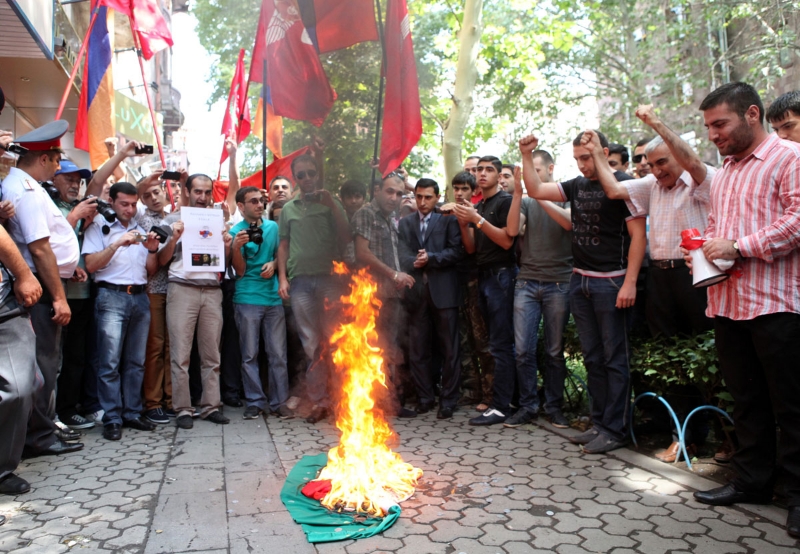
Worldwide, Headline, Daily news | ankakh | May 31, 2010 15:37 Since July 1993, the Republic of Turkey has undertaken a war measure1 with regards to Armenia, as international law considers a blockade to be as such. To this day, Armenia’s desire to lift the blockade on its western and southern border has been in vain. As long as our just demand is not supported by international law, that is to say, as long as leverage of a certain kind is not applied, our lamenting cries to Turkey to open this so-called “Armenia-Turkey border” will continue to be dismissed or have absolutely unacceptable conditions imposed upon them. All this, while the leverage as per international law is ours for the taking. Consider the following:
1. By the very first international document adopted by the Republic of Turkey – the Treaty of Lausanne (of the 24th of July 1923) – the country gave assurances that it would abide by free and non-discriminatory transit as per the Convention, Statute and supplementary Protocol, of the Conference of Barcelona, of April 1921.
Article 101 of the Treaty of Lausanne states that, “Turkey undertakes to adhere to the Convention and to the Statute respecting the Freedom of Transit adopted by the Conference of Barcelona on the 14th April 1921, as well as to the Convention and the Statute respecting the regime for waterways of international interest adopted by the said Conference on the 19th April 1921, and to the supplementary Protocol.”
Article 2 of the Barcelona Statute on Freedom of Transit alluded to in the aforementioned clause, states outright that the parties, “across territory under their sovereignty or authority shall facilitate free transit by rail or waterway on routes in use convenient for international transit. No distinction shall be made which is based on the nationality of persons, the flag of vessels, the place of origin, departure, entry, exit or destination, or on any circumstances relating to the ownership of goods or of vessels, coaching or goods stock or other means of transport.”
By another section of the Treaty of Lausanne, Article 104, Turkey is obliged “to adhere to the recommendations of the Conference of Barcelona, dated the 20th April 1921, respecting international railways.”
Turkey reaffirmed its obligation to abide by the Barcelona Convention and Statute on Freedom of Transit on the 27th of July 1933 by directly acceding to it.
2. During the 656th plenary session of the UN General Assembly (on the 20th of February 1957), by Resolution 1028(XI), the issue of land-locked countries2 and the expansion of international trade was brought up for the first time. The resolution, recognising the necessity to provide corresponding transit possibilities to land-locked countries for the development of international commerce, “invites the Governments of Member States to give full recognition to the land-locked Member states in the matter of transit trade and, therefore, to accord them adequate facilities in terms of international law and practice in this regard.”
3. On the 25th of May 1969, the Republic of Turkey acceded to the Convention on Transit Trade of Land-locked States (New York, the 8th of July, 1965).
This convention’s first principle recognises that, “the right of each land-locked State of free access to the sea is an essential principle for the expansion of international trade and economic development.”
The third principle of the convention recognises the right to free access to the sea for land-locked countries, stating, “In order to enjoy the freedom of the seas on equal terms with coastal States, States having no sea coast should have free access to the sea.”
Moreover, the fourth principle of this convention decidedly states that, “Goods in transit should not be subject to any customs duty,” and that, “Means of transport in transit should not be subject to special taxes or charges higher than those levied for the use of means of transport of the transit country.”
As an aside, Georgia has acceded to the Convention on Transit Trade of Land-locked States as well (on the 2nd of June 1999). Thus, in charging Armenian goods in transit more than Georgian ones, the Georgian authorities are unquestionably disregarding the international obligations, which they bear.
The aforementioned principles are codified in articles 2 and 3 of the convention. The first clause of Article 2 states that, “Freedom of transit shall be granted under the terms of this Convention for traffic in transit and means of transport. (…) Consistent with the terms of this Convention, no discrimination shall be exercised which is based on the place of origin, departure, entry, exit or destination or on any circumstances relating to the ownership of the goods or the ownership, place of registration or flag of vessels, land vehicles or other means of transport used.”
Article 3 takes up customs and transit dues, stating, “Traffic in transit shall not be subjected by any authority within the transit State to customs duties or taxes chargeable by reason of importation or exportation nor to any special dues in respect of transit.”
The Republic of Armenia has not yet acceded to the Convention on Transit Trade of Land-locked States. In order that the Republic of Armenia may fully be in a position to defend its rights when it comes to free transit of goods, it ought to, first of all, accede to this convention.
And so, whereas the Republic of Turkey, in exercising a blockade on the Republic of Armenia, has utterly violated,
Articles 101 and 104 of the Treaty of Lausanne (of the 24th of July, 1923);
Article 2 of the Barcelona Statute on Freedom of Transit (of the 20th of April, 1921);
UN General Assembly Resolution 1028(XI) (of the 20th of February, 1957);
Principles I, III and IV, as well as articles 2 and 3 of the Convention on Transit Trade of Land-locked States (of the 8th of July, 1965);
And considering that,
Article 55.(b) of the UN Charter calls on the UN to “promote solutions of international economic, social, health, and related problems; and international cultural and educational co-operation”;
the first paragraph under heading X of the Helsinki Final Act declares that states party to the document, “will fulfil in good faith their obligations under international law, both those obligations arising from the generally recognized principles & rules of international law & those obligations arising from treaties or other agreements, in conformity with international law, to which they are parties”;
Thus, the Republic of Armenia is able and is obliged to defend its rights based on international law, to carry out goal-oriented and consistent steps towards lifting the blockade on Armenia.
As a member of the UN, the Republic of Armenia has absolute right to, “bring any dispute, or any situation of the nature referred to in Article 34 [of the UN Charter], to the attention of the Security Council or of the General Assembly,” as per the first clause of Article 35 of the UN Charter.
Article 34 of the UN Charter states that, “The Security Council may investigate any dispute, or any situation which might lead to international friction or give rise to a dispute, in order to determine whether the continuance of the dispute or situation is likely to endanger the maintenance of international peace and security.”
With the initiative of the Republic of Armenia, drawing the Security Council’s attention to the consistent non-compliance of international obligations and consequent clear, absolute, multiple and ill-intentioned violations of international law by Turkey would offer serious support in the political process of lifting the blockade on the Republic of Armenia.
Ara Papian
Head, “Modus Vivendi” Centre
(This article was first published in the 3rd April 2007 issue of the “AZG” daily in Armenia)

 Facebook
 Tweet This
 RSS Feed
 Email This Post


 Loading ...